, Pressemitteilung
Deutschland und Estland schließen Innovationspartnerschaft
Zusammenarbeit bei KI, digitaler Souveränität, EUDI-Wallet, öffentlicher Beschaffung und Cybersicherheit vereinbart
Pressemitteilung 27/2026
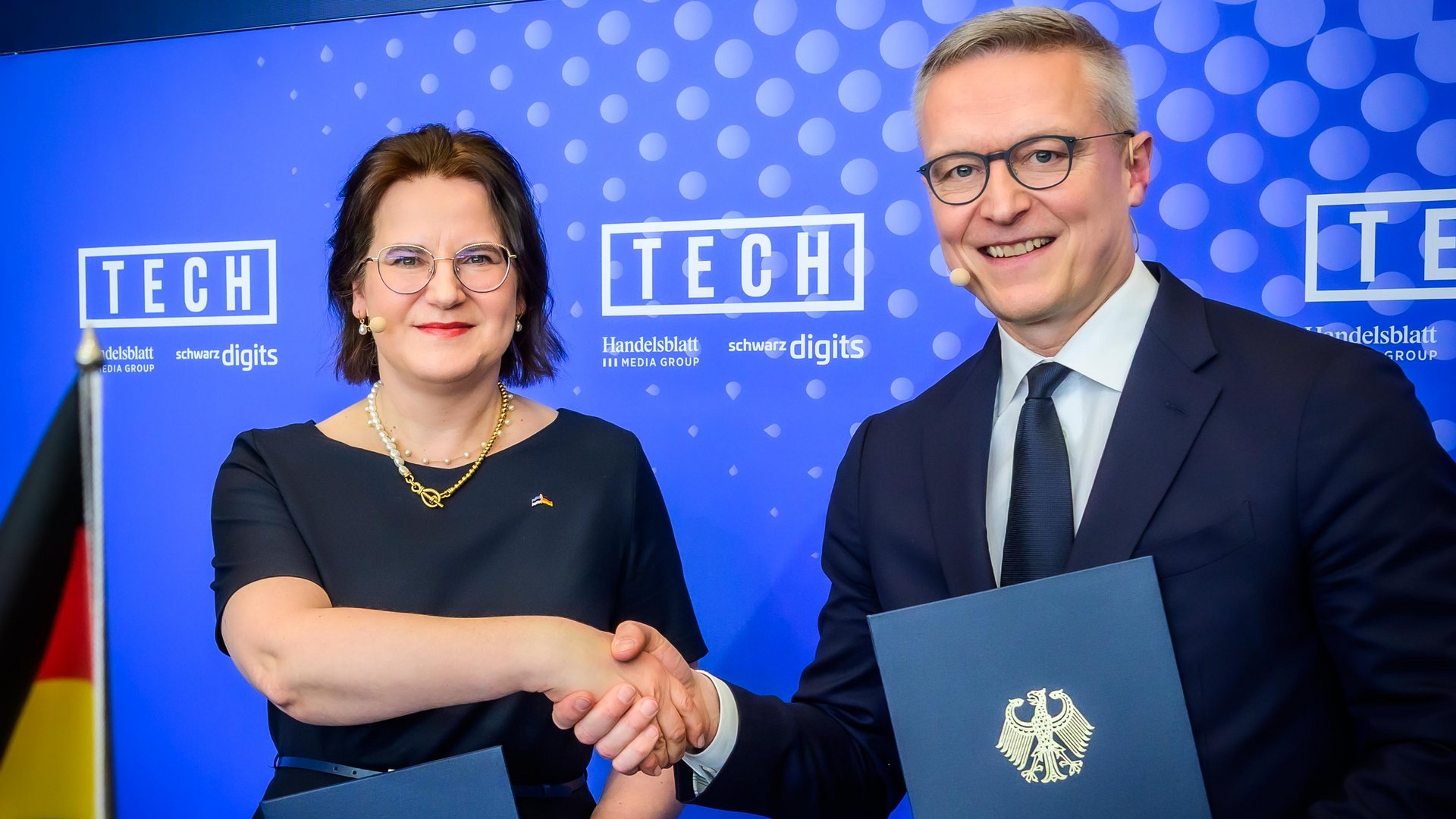
Deutschland und Estland haben eine gemeinsame Absichtserklärung für eine Innovationspartnerschaft geschlossen. Der Bundesminister für Digitales und Staatsmodernisierung. Dr. Karsten Wildberger, und seine estnische Amtskollegin Liisa-Ly Pakosta haben im Rahmen der TECH in Heilbronn ein Memorandum of Understanding unterzeichnet. Darin vereinbaren beide Seiten eine vertiefte Zusammenarbeit in zentralen Feldern wie Künstliche Intelligenz, digitale Souveränität, Staatsmodernisierung und Cybersicherheit in der öffentlichen Verwaltung.
Bundesdigitalminister Dr. Karsten Wildberger:
„Estland ist eines der führenden digitalen Länder Europas und für Deutschland ein wichtiger und verlässlicher Partner. Mit der gemeinsamen Absichtserklärung vertiefen wir unsere Zusammenarbeit in zentralen Zukunftsfeldern wie Künstlicher Intelligenz, digitaler Souveränität und einer modernen öffentlichen Verwaltung. So stärken wir gemeinsam die Innovationskraft des Staates und schaffen die Grundlage für leistungsfähige, sichere und nutzerorientierte digitale Lösungen in Europa.“
Estlands Justiz- und Digitalministerin Liisa-Ly Pakosta:
„Estland und Deutschland sind zwei technologisch hochentwickelte Länder mit sehr ähnlichen Rechtssystemen. Dies bietet uns die Chance, Europa zu zeigen, wie Innovation grenzüberschreitend und praktisch umgesetzt werden kann - zum Nutzen unserer Volkswirtschaften und unserer Bürgerinnen und Bürger. Für Estland darf diese Partnerschaft nicht nur auf der Ebene von Grundsätzen bleiben. Die Vereinbarung enthält konkrete Ansätze, und wir haben einen Plan, diese umzusetzen: neue Chancen für estnische Unternehmen zu eröffnen und ihre Erfahrungen und Lösungen wirksamer auf den deutschen Markt zu bringen.“
Deutschland und Estland knüpfen mit der Vereinbarung an ihre langjährige enge und vertrauensvolle Zusammenarbeit im Bereich der Digitalisierung zwischen den beiden Ländern an. Ziel der Partnerschaft ist es, den Austausch von Erfahrungen, Best Practices und politischen Ansätzen zu intensivieren und gemeinsame Projekte von beiderseitigem Interesse voranzubringen.
Im Mittelpunkt der Zusammenarbeit stehen der Austausch zu agentischer KI und KI-Plattformen im öffentlichen Sektor, die Weiterentwicklung sicherer und interoperabler souveräner staatlicher Cloud-Lösungen, die Digitalisierung und Vereinfachung öffentlicher Beschaffung sowie der operative und technische Einsatz der europäischen digitalen Identitätswallet. Zudem wollen beide Seiten ihre Zusammenarbeit bei der Cybersicherheit in der öffentlichen Verwaltung, auch zwischen dem BSI und der estnischen Informationssystembehörde RIA, vertiefen.
Joint Innovation Partnership
between
The Federal Ministry of Digital Transformation and Government Modernisation of
the Federal Republic of Germany
and
The Ministry of Justice and Digital Affairs of the Republic of Estonia
Introduction
The Federal Ministry of Digital Transformation and Government Modernisation of the Federal Republic of Germany and the Ministry of Justice and Digital Affairs of the Republic of Estonia (thereafter: Germany and Estonia) emphasize the traditionally friendly relations between both sides and stress the good experiences in cooperation.
Secure digitalisation is one of the defining features of our age and a cornerstone for future growth, welfare and trust in our societies. Estonia and Germany share the ambition to build innovative, and human-centric digital societies, while strengthening Europe’s ability to compete globally. Our cooperation will build on the exchange of best practices and coordination in European fora to develop joint projects of common interests. Together we intend to shape digital policies that promote openness, innovation and digital sovereignty as follows:
This Joint Innovation Partnership aims to foster cooperation on innovation in the following areas:
1. Agentic AI and AI Platforms
Estonia and Germany will cooperate in sharing concepts, prototype approaches, best practices, lessons learnt, and policies on how to foster the development and adoption of Agentic AI and AI platform technologies in the public sector of both countries. This may include exchange on working level and/or on specific projects. Cooperation will align with the GDPR and European frameworks on AI governance, ensuring that personal data is processed responsibly, securely, in a transparent way and only for clearly defined purposes.
Cooperation will include the following joint projects:
a. Exploring opportunities to align their approaches in the development of AI platforms such as AI sandboxes, trustworthy AI toolbox, agentic solutions, and large-scale public sector use cases, through joint pilots, interoperability of solutions, and the use of open-source components where applicable.
b. Exchanging best practices and possible deployment of use cases of privacy enhancing technologies (PETs) for the secure usage of AI.
c. Exploring opportunities for joint projects under the European Competitiveness Fund (ECF) as part of the Multi-Annual Financial Framework (MFF 2028+), including, for example, interoperability purposes and developing new standards for AI development.
2. Digital Sovereign Infrastructure
Estonia and Germany will work together and share best practices and policies on how to strengthen digital sovereignty, including by exchanging experiences of using sovereign digital solutions in the public sector, while considering and creating synergies with existing European processes that aim at strengthening European digital sovereignty.
Cooperation will include the following joint projects:
a. Share best practices in developing a secure and interoperable state cloud ecosystem, supporting data sharing, service scalability, and alignment with European sovereign cloud initiatives.
b. Exchange experiences of modernizing legacy systems, focusing on interoperability, and identifying solutions adaptable to each country’s context.
3. Modernisation of Public Procurement
Estonia and Germany will make innovation readily available to public administration and strengthen the shared European digital economy. Estonia and Germany will therefore collaborate and exchange experiences in establishing their own central procurement units and platforms. Estonia and Germany intend to exchange their own experiences and proposals that could lead to legal simplification in the area of public procurement.
Cooperation will include the following joint projects:
a. Strengthen cooperation by enhancing proactive information exchange on upcoming innovation- and digital solutions-based public procurement initiatives in both countries, including innovative procurement approaches in the field of AI.
b. Share experiences in developing solutions, regarding the digitalization of public procurement, e.g. through platforms, registers or the idea of moving from a document-based approach to data-based approach.
c. Share experiences in developing and utilizing AI regarding the preparation and execution of public procurement procedures, e.g. preparing procurement documents.
d. Intend to exchange ideas regarding positions in areas of common interest regarding the reform of the EU public procurement, e.g. on simplification procurement processes.
4. EUDI-Wallet
Estonia and Germany intend to engage in an open exchange of best practices regarding the operational and technical use of the EU Digital Identity Wallet.
Cooperation will include the following joint projects:
a. Certification related to conformity assessment, security requirements on identifying bottlenecks and aligning approaches to streamline certification across Member States.
b. Collaboration on the development and testing of concrete use cases, prioritizing high-impact cross-border scenarios (business registration, professional credentials, and service access).
c. Position ourselves to initiate a new Large-Scale Pilot (LSP) at the EU level, together with a consortium of national partners, to explore the development of a Sovereign European payment connector for the EUDI Wallet.
5. Cybersecurity cooperation in the area of public administration
Estonia and Germany will work together on cybersecurity efforts in the area of public administration to enhance and strengthen ongoing initiatives and projects.
This will entail close cooperation between national cybersecurity authorities, the Federal Office for Information Security (Bundesamt für Sicherheit in der Informationstechnik, BSI) and the Republic of Estonia Information System Authority (Riigi Infosüsteemi Amet, RIA) and, as appropriate, the respective ministries pursuant to this agreement in
a. implementing relevant legislation and thereby ensure a heightened and uniform level of security in their countries,
b. sharing and pooling knowledge and expertise, especially with regard to best practices, to strengthen and develop cybersecurity capabilities,
c. cooperating on innovative approaches to increase the cyber resilience of public institutions.
This will also entail close cooperation between national coordination centres for cybersecurity to
d. strengthen cooperation between both national coordination centres for cybersecurity (NCCs),
e. carry out joint events to support innovation in the cybersecurity industry by the NCCs in Germany and Estonia.
This Joint Innovation Partnership will be applied starting on the day of signature. Each side may end the cooperation at any time. It should inform the other side in writing of its intention to end cooperation at least three months prior.
This Joint Innovation Partnership may be amended at any time by mutual consent; amendments should be done in writing.
This Joint Innovation Partnership is not intended to constitute a treaty, nor to create rights or obligations for any side under international law.
The Participants may invite other institutions, including the private sector and non-governmental sector, or other levels of government, to participate in the work and assign them the responsibility for the implementation of particular activities.
This Joint Innovation Partnership was signed in two copies on June 1, 2026 in Heilbronn (Germany), in the English language.
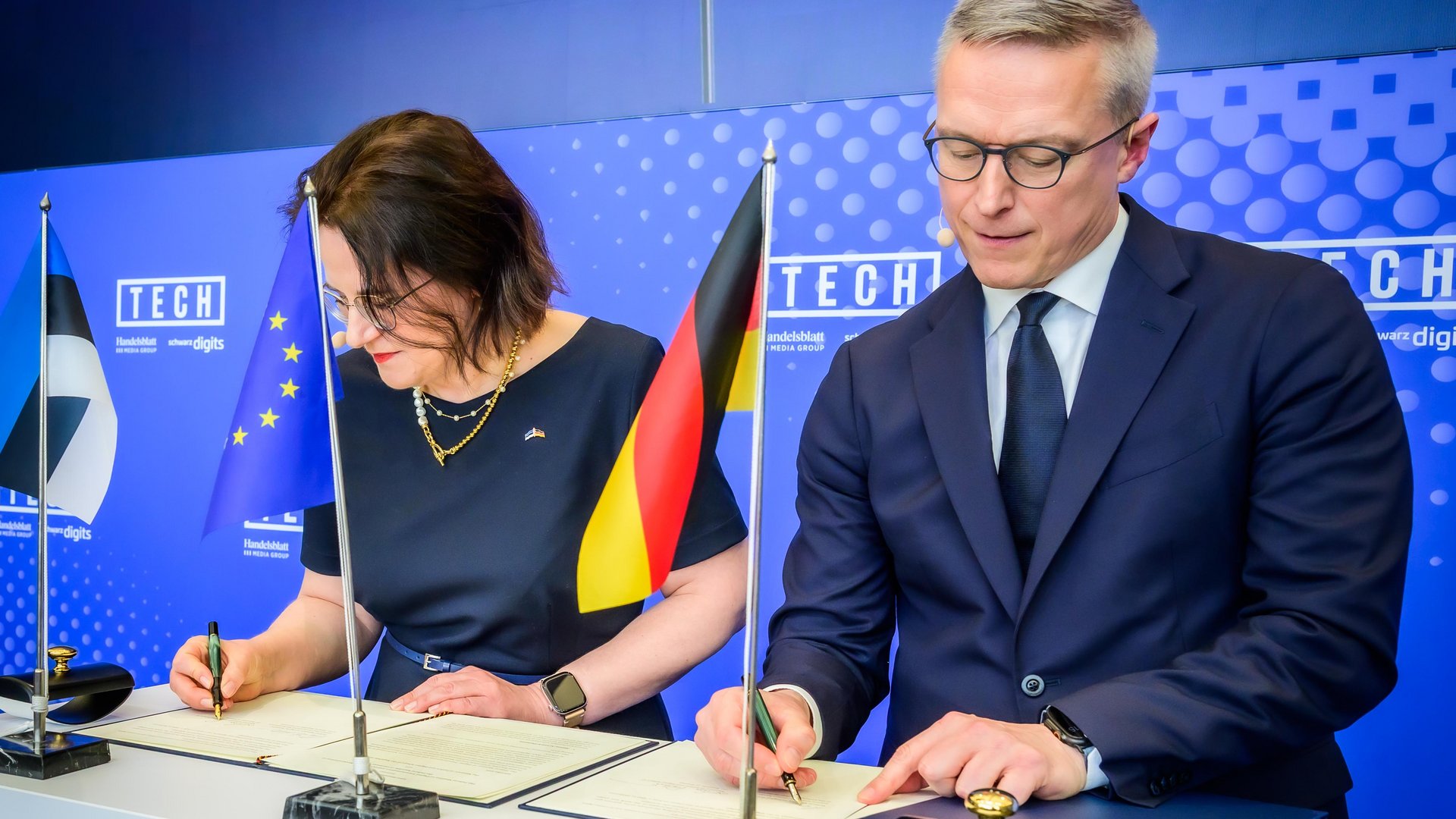
Estlands Justiz- und Digitalministerin Liisa-Ly Pakosta und Bundesdigitalminister Dr. Karsten Wildberger unterzeichnen ein Memorandum of Understanding.