
, Pressemitteilung
Deutschland und Indien schließen Pakt für KI
Bundesdigitalminister Wildberger und Indiens IT-Minister Vaishnaw vertiefen strategische Partnerschaft
Pressemitteilung 09/2026
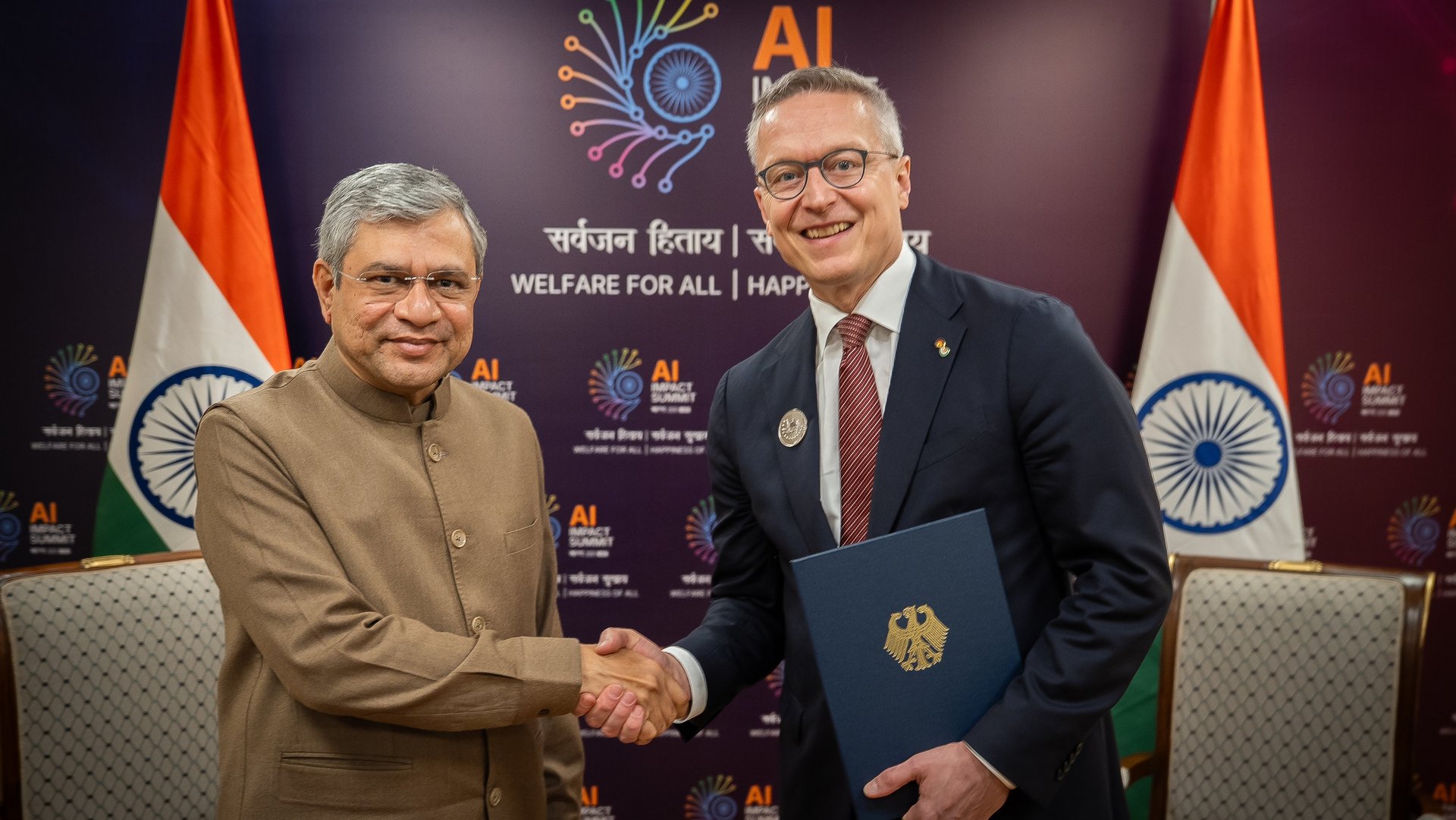
Deutschland und Indien vertiefen ihre Zusammenarbeit im Bereich der Künstlichen Intelligenz (KI). Beim AI Impact Summit in Neu-Delhi haben Bundesdigitalminister Dr. Karsten Wildberger und sein indischer Amtskollege Ashwini Vaishnaw, Minister für Elektronik und Informationstechnologie, heute den deutsch-indischen KI-Pakt als neue Leitinitiative der bilateralen Digitalpartnerschaft gestartet.
Der KI-Pakt baut auf dem seit 2017 bestehenden Digitaldialog der beiden Länder auf. Bereits im Januar 2026 haben das BMDS und sein indisches Partnerministerium, das Ministerium für Elektronik und Informationstechnologie (MeitY), gemeinsame Projekte in den Bereichen KI, Halbleiter, Industrie 4.0, digitale Zahlungen und Start-ups für die nächsten beiden Jahre vereinbart. Mit dem KI-Pakt gehen beide nun einen Schritt weiter.
Bundesdigitalminister Dr. Karsten Wildberger
„Deutschland und Indien vertiefen bei Digitalisierung und KI ihre Zusammenarbeit. Indische Software- und KI-Talente treffen deutschen Mittelstand, KI-Start-ups und Industrie 4.0. Mit dem KI-Pakt bündeln wir diese Stärken und füllen das vor kurzem geschlossene Freihandelsabkommen mit Leben. Damit schaffen wir Wachstumschancen für deutsche Unternehmen, diversifizieren Wertschöpfungsketten und stärken unsere digitale Souveränität."
Der deutsch-indische KI-Pakt enthält Initiativen in sechs Handlungsfeldern:
- KI für Industrie und Mittelstand, insbesondere in den Bereichen Mobilität, Energie, Gesundheit, Landwirtschaft und Smart Manufacturing
- Vertrauenswürdige und ethische KI, inklusive Austausch zur Umsetzung des EU AI Act und der India AI Mission
- Förderung von Talenten, Kompetenzen und der Mobilität von Fachkräften in der Digitalwirtschaft
- Forschung, Innovation und KI-Infrastruktur, einschließlich Rechenkapazitäten und sektoraler KI-Modelle
- KI in der öffentlichen Verwaltung und für soziale Zwecke
- Abstimmung in internationalen Foren wie dem AI Impact Summit und der Global Partnership on AI (GPAI)
Deutschland und Indien bekennen sich in einer gemeinsamen Erklärung dazu, KI verantwortungsvoll, sicher und im Einklang mit demokratischen Werten zu gestalten. Beide Regierungen wollen insbesondere kleine und mittlere Unternehmen sowie Start-ups dabei unterstützen, KI-Lösungen schneller und vertrauenswürdig auf den Markt zu bringen.
Dazu wollen beide Seiten Anlaufstellen für Unternehmen und Start-ups einrichten, die gezielt deutsch-indische KI-Partnerschaften fördern. Unter anderem sollen Verbände wie NASSCOM, der Bundesverband mittelständische Wirtschaft und der KI-Bundesverband enger miteinander kooperieren.
Deutschland präsentiert sich auf internationaler AI Expo in Delhi
Anlass des Aufenthalts in Indien ist Wildbergers Teilnahme am AI Impact Summit in Neu-Delhi, an dem mehr als 100 Regierungsvertreter vom 17. bis 20. Februar 2026 auf Einladung des indischen Premierministers Narendra Modī teilnehmen. Deutschland präsentiert sich dort mit einem eigenen Pavillon.
Der Bundesdigitalminister wird von einer hochrangigen Wirtschaftsdelegation begleitet – unter anderem aus der Automobilindustrie, der Software- und Plattformwirtschaft sowie der deutschen KI-Start-up-Szene.
Veröffentlicht am: 18. Februar 2026
Joint Press Release on Germany–India AI Pact

Ashwini Vaishnaw, Minister of Electronics and Information Technology of the Republic of India and Karsten Wildberger, Federal Minister for Digital Transformation and Government Modernisation of the Federal Republic of Germany, met on the margins of the AI Impact Summit in New Delhi on February 18, 2026.
The Ministers reaffirmed the strong and trusted partnership between Germany and India, grounded in shared democratic values, respect for the rule of law, and a commitment to shaping digital transformation in a human-centric, inclusive, development-oriented approach, and responsible manner. They recalled that digital cooperation has become important in India-German relations, institutionalised through the India-German Digital Dialogue since 2017 and further strengthened through the signing of the Work Plan 2026 –2027 on January 16, 2026, in Berlin.
Against the backdrop of rapid advances in artificial intelligence and their farreaching economic, societal, and developmental implications, the Ministers agreed to launch an India-Germany AI Pact as a flagship
initiative to translate dialogue and engagements into concrete, implementation-oriented bilateral cooperation.
The India-Germany AI Pact
The India-Germany AI Pact aims to establish a partnership focused on implementation-driven collaboration, across government, industry, research, skill-development and innovation.
It reflects the shared conviction that AI should drive innovation, strengthen economic growth and competitiveness, boost productivity and manufacturing capabilities and support sustainable development while being developed and deployed in a manner that is safe, trustworthy and beneficial to society.
Under the AI Pact, Germany and India intend to advance cooperation in the following priority areas:
1. AI for Industry and Manufacturing
Recognising the transformative potential of AI for manufacturing and strategic sectors, the Pact will promote collaboration on industrial AI, including use cases in infrastructure, mobility, energy, healthcare,
agriculture, productivity and smart manufacturing. Germany and India will encourage partnerships between start-ups, tech companies, SMEs, industry associations, to foster cross-border partnerships on AI technology, accelerate AI adoption, and enhance productivity and competitiveness. To this end, both countries have agreed to set up dedicated points of contact in the near future to assist cooperation between industry associations and tech-organisations.
2. Trustworthy and Ethical AI
Both sides will deepen exchanges on responsible AI, including exchange of experiences related to the EU AI Act and national policies of India as well as data privacy regulations. Cooperation will focus on transparency, risk-management and responsible development and deployment of AI, while avoiding unnecessary and restrictive regulatory frameworks that could restrict innovation and hinder economic growth.
3. Talent, Skills, Mobility, Technology
The Ministers highlighted that access to skilled talent is a critical enabler for creating AI ecosystems. Under the AI Pact, both sides will strengthen cooperation on AI skill development, training, and talent promotion including through networking between industry, start-ups, and research institutions.
To this end, it is agreed to identify research institutes on both sides to facilitate cooperation in training, skill development and talent promotion. It is also agreed to set up a dedicated point of contacts in both countries in line with applicable domestic laws to facilitate mobility of students and skilled professionals from India under the recent European initiatives
4. Research, Innovation, and Infrastructure
Germany and India will explore joint research in AI, including cooperation on building AI infrastructure, strengthening compute capacity, and developing sector-specific models such as language and vision models. The Pact will support collaboration between research institutions, start-ups and technology companies to advance applied research, support AI applications, and accelerate commercialisation.
5. AI for Social Good
Both sides expressed interest in exchanging best practices on the use of AI to enhance efficiency in governance, public service delivery and public participation. Cooperation will also explore exchange of best practices, knowledge, learnings on AI applications for social good, aligning with sustainability, inclusivity, and accessibility objectives.
6. Implementation and Next Steps
The Ministers agreed that the India-Germany AI Pact will be implemented through the established India-German Digital Dialogue. The identified areas would also be implemented through multi-stakeholder
engagements by bringing industry, private sector, research institutes, academia. As an initial step, both sides will designate focal points from both governments to develop a focused work programme under the Pact, building on the AI chapter of the Work Plan 2026–2027 and identify early pilot initiatives and deliverables.
The Ministers committed to maintaining regular exchanges to review the progress of the Pact. They expressed confidence that the India-Germany AI Pact will strengthen bilateral cooperation and deliver tangible outcomes to ensure mutual benefits